
Finding Cleveland Residents by Record Type
Names and addresses lead to different Cleveland residents directory sources. A present address belongs first in Cuyahoga County MyPlace, where an owner, parcel, or address search can open a parcel record. A known name may instead call for the Ohio voter tool, a court party index, a vital-record copy route, or a historical directory. Each record describes a particular connection to Cleveland, not a complete household.
Work from the most stable fact. Keep the parcel number with the address, keep a case number with a court result, and retain the directory year with any historical listing. A property owner's mailing address can differ from the physical situs, and an indexed party can be a former owner or a litigant. That is why a Cleveland residents directory search works best as a short chain of independent records.
- Search MyPlace by address, owner, or parcel to establish the present property record and retain the parcel number.
- Use Ohio Voter Search for a known first name, last name, and county when registration confirmation is the question.
- Check the Official Records Search for an instrument tied to the parcel, address, or named party.
- For a past household, compare a dated city directory with maps, tax material, and census records held by local repositories.
- When the needed item is absent online, ask the named custodian for it through the correct counter, copy route, or public-records request.
Cleveland Residents and Record Custodians
Cleveland is the Cuyahoga County seat, so many resident leads start with county rather than city custody. Transfer & Recording maintains the deed and parcel side, MyPlace supplies the current parcel view, and the Board of Elections handles local election records. The offices below are useful starting points, but their records answer different questions. The Cleveland street directory route is the place to follow an address across a full block or street.
Fiscal Officer, Transfer & Recording
2079 East Ninth Street, fourth floor
Cleveland, OH 44115
216-443-2060
Cuyahoga County Property Data
County parcel, transfer, value, and tax records
Cleveland and Cuyahoga County
Use the property portal for a parcel path
Cleveland Residents Through MyPlace
MyPlace is the County's address-facing tool. Select Cleveland, then choose Owner, Parcel, or Address before opening the parcel record. Its visible paths include General Information, Transfers, Values, Land, Building Information, Permits, Tax By Year, a document list, map view, and address CSV download. Those paths make it a strong Cleveland residents directory starting point for a property question, but the County says the geographic display is not the controlling official record.
| MyPlace path | Useful Cleveland record clue |
|---|---|
| City and Address | Starts an address-specific parcel search. |
| Owner | Finds a parcel associated with a recorded owner name. |
| Parcel | Preserves the county identifier that links property materials. |
| Transfers and document list | Points onward to the ownership and recorded-document trail. |
See the MyPlace property-search screen before starting a parcel search.
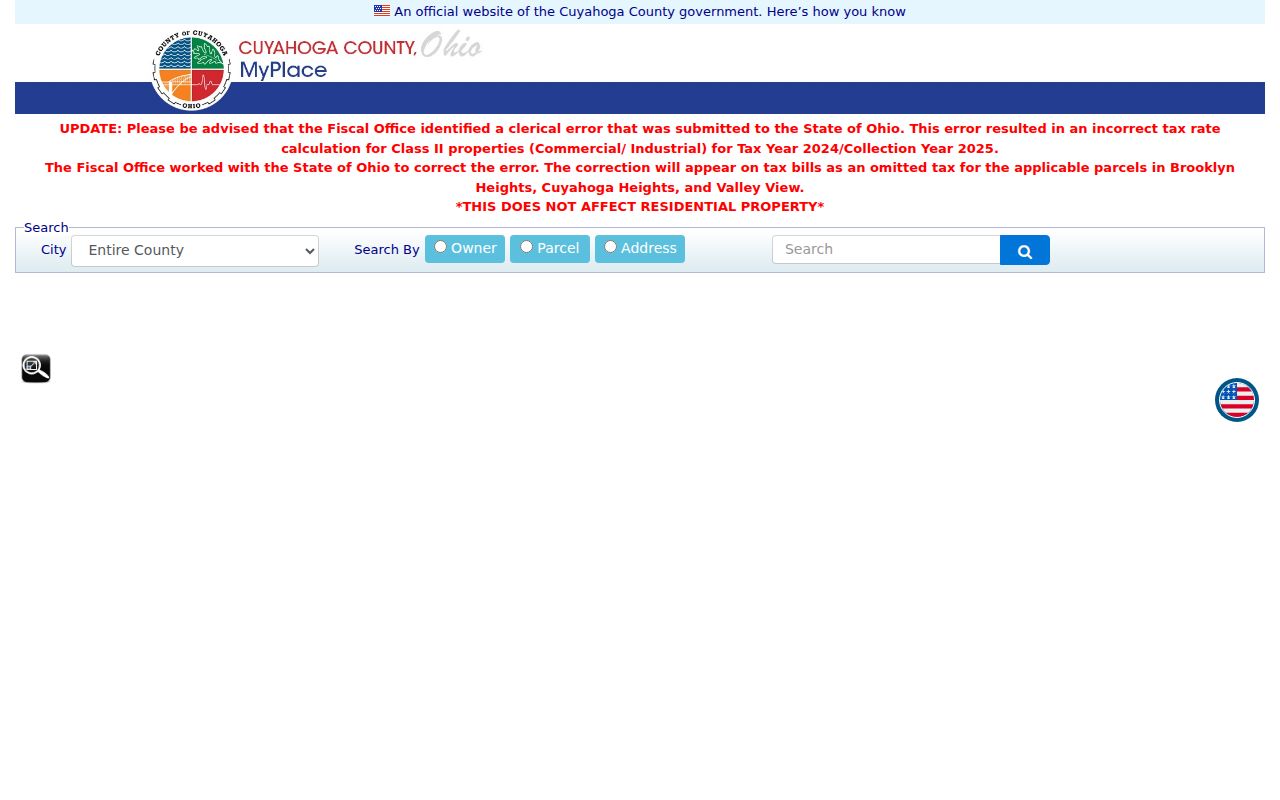
The MyPlace screen shows why a physical address and the county parcel number should stay together when a Cleveland residents directory search moves to deeds or archive material.
Cleveland Resident Election Confirmation
Ohio's official voter lookup is useful after a name is already known. The form requires first name, last name, and county, then confirms registration with precinct and polling information. It is not an address-browse roster. The more detailed official alternative is the Secretary of State's DATA Act voter archive, which publishes daily county snapshots for at least 22 months under Ohio Revised Code 149.43 and has its own date and county limits.
The Cuyahoga Board of Elections also offers an office route and a public-records policy. Election records carry protected fields and confidential-participant rules, so a missing result does not prove a person has no connection to Cleveland. Use the tool to test a known-name question, then preserve the date checked and any precinct context rather than treating the result as a current household list.
Note: Cleveland voter information is one corroborating record, not proof that every person at an address is registered or publicly listed.
Current Cleveland Residents Directory Sources
Current directory-like records in Cleveland each represent a narrow role. A parcel record concerns ownership and property administration; a recorder index concerns parties to recorded filings; an election tool confirms registration for a known name. Libraries, archives, and community organizations offer other public-facing routes, but the research does not support treating any of them as a universal resident list.
| Cleveland source | Connection shown | Custodian | Access path |
|---|---|---|---|
| MyPlace property record | Parcel, owner, transfers, values, and tax paths | Cuyahoga County Fiscal Officer | Public online portal |
| Ohio Voter Search | Known-name registration, precinct, and polling information | Ohio Secretary of State | Name plus county lookup |
| Official Records Search | Grantor, grantee, document, parcel, address, or legal-description trail | Transfer & Recording | Public index and office route |
| Cleveland permit history | Documented permit or violation activity at an address | Building & Housing | Accela, counter, or request |
| CDC contact directory | Community organization contacts by service area | City GIS and Cleveland Neighborhood Progress | Public organization directory |
When the question narrows to one person, a Cleveland resident lookup compares names, dates, court divisions, and official copies rather than relying on one index.
Cleveland Residents in Recorded Documents
The Fiscal Officer says Cuyahoga recorded documents are searchable from 1810 to the present. Official Records Search supports party names, grantor, grantee, recorded and instrument date ranges, document type, document number, parcel ID, volume and page, property address, legal-description fields, and image-text searching. Parcel IDs must include dashes. A deed or lien identifies parties to a filing, not every person who lived at the property.
The quick search can use index-only or Index & Full Text OCR scope. In index-only mode, multiple terms are searched individually; in OCR they are handled as a phrase. Start with the known parcel or recorded party, save the document number, and verify an important ownership conclusion through the recorded instrument or the fourth-floor office. The free Property Alert service can monitor a name, entity, keyword, or individual document, but the County warns that it is not title assurance.
| Official Records field | Input | How it narrows a Cleveland search |
|---|---|---|
| Party Names, Grantor, or Grantee | Last name, then first name | Finds a named party in a recorded filing. |
| Recorded or instrument date | MM/DD/YYYY range | Limits a result to a known ownership period. |
| Parcel ID | Include dashes | Connects an instrument to the county property trail. |
| Property address | Text field | Provides an address-index route when a document is known. |
| Document image | Phrase field | Uses the portal's OCR image-search path. |
Open the Cuyahoga Official Records Search to see the public quick-search controls.
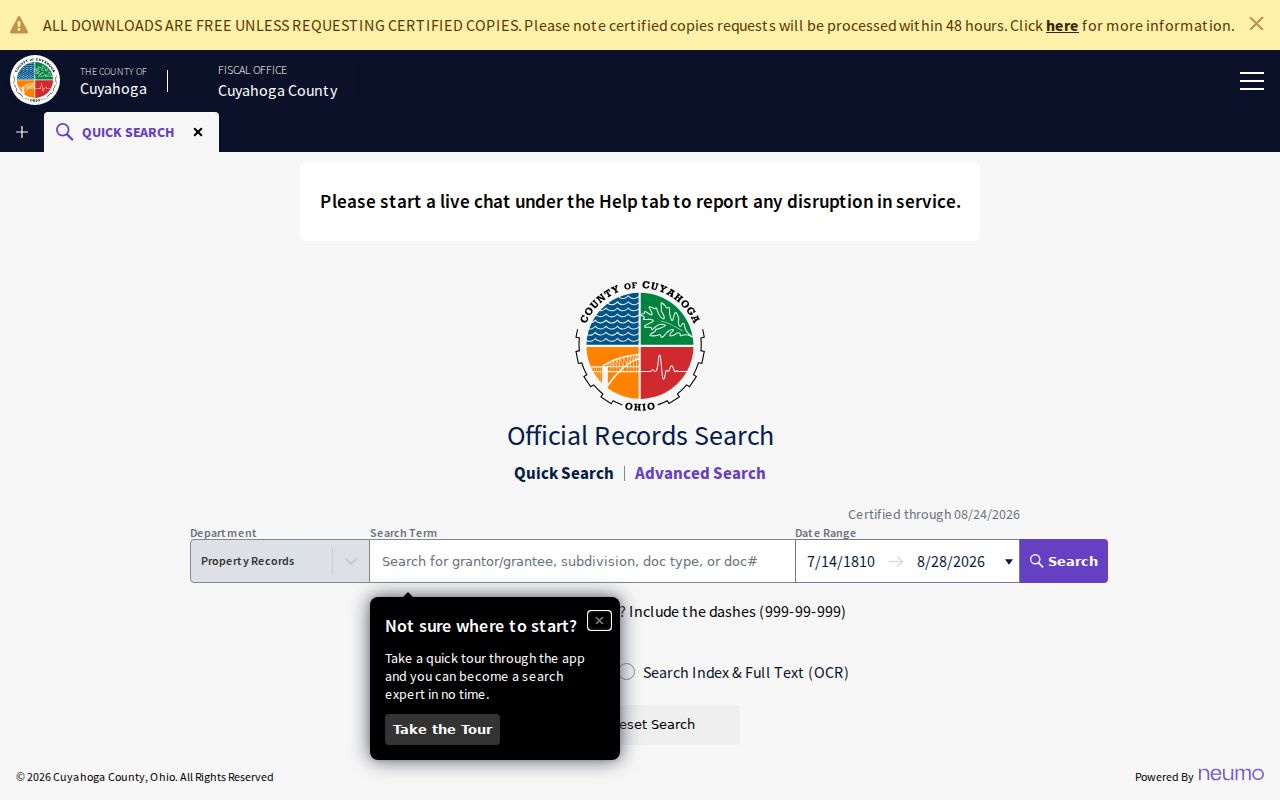
The recorded-document interface supplies the fields needed to turn a Cleveland residents directory property lead into a checkable instrument trail.
Cleveland Resident Names in Court Indexes
Cuyahoga court systems are separate. The Clerk Web Docket covers Common Pleas civil and domestic, criminal, foreclosure, e-filed complaint, and appellate paths. Cleveland Municipal Court has its own case-information system. Probate has a separate docket for estates, trusts, guardianships, adoptions, marriage matters, and related files. A court result belongs to a case file, so compare the division, case number, party role, filing date, and case status before treating a shared name as a match.
Remote access also has real limits. Domestic Violence and Civil Stalking Protection Order cases are not available through the Common Pleas internet path. Probate warns that electronic data can be incomplete or inaccurate, and Domestic Relations restricts many remote documents. The clerk counter or a court copy route is the way to verify an important result.
The Cuyahoga Clerk Web Docket shows the distinct Common Pleas search categories.
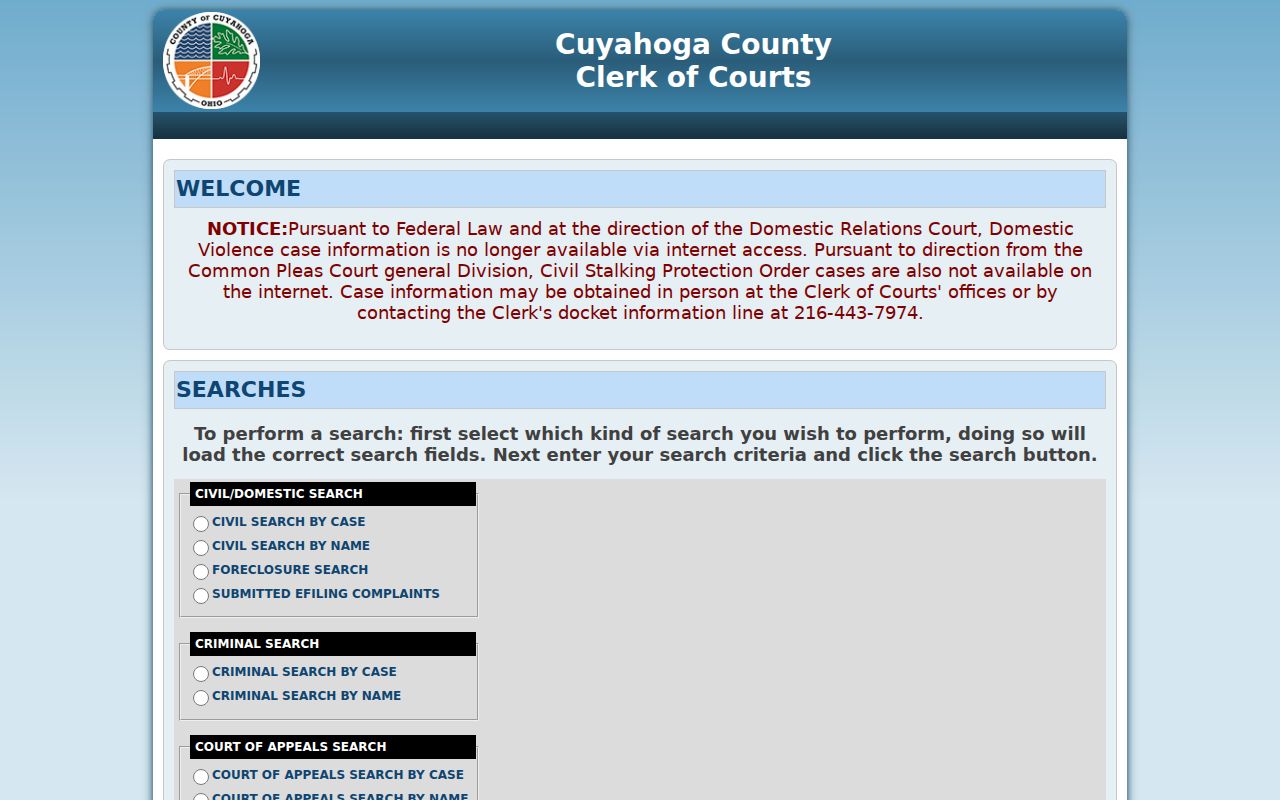
The category screen makes clear that a Cleveland residents directory name search has to begin with the right court division.
The Cleveland Municipal Court provides a separate case-information route.
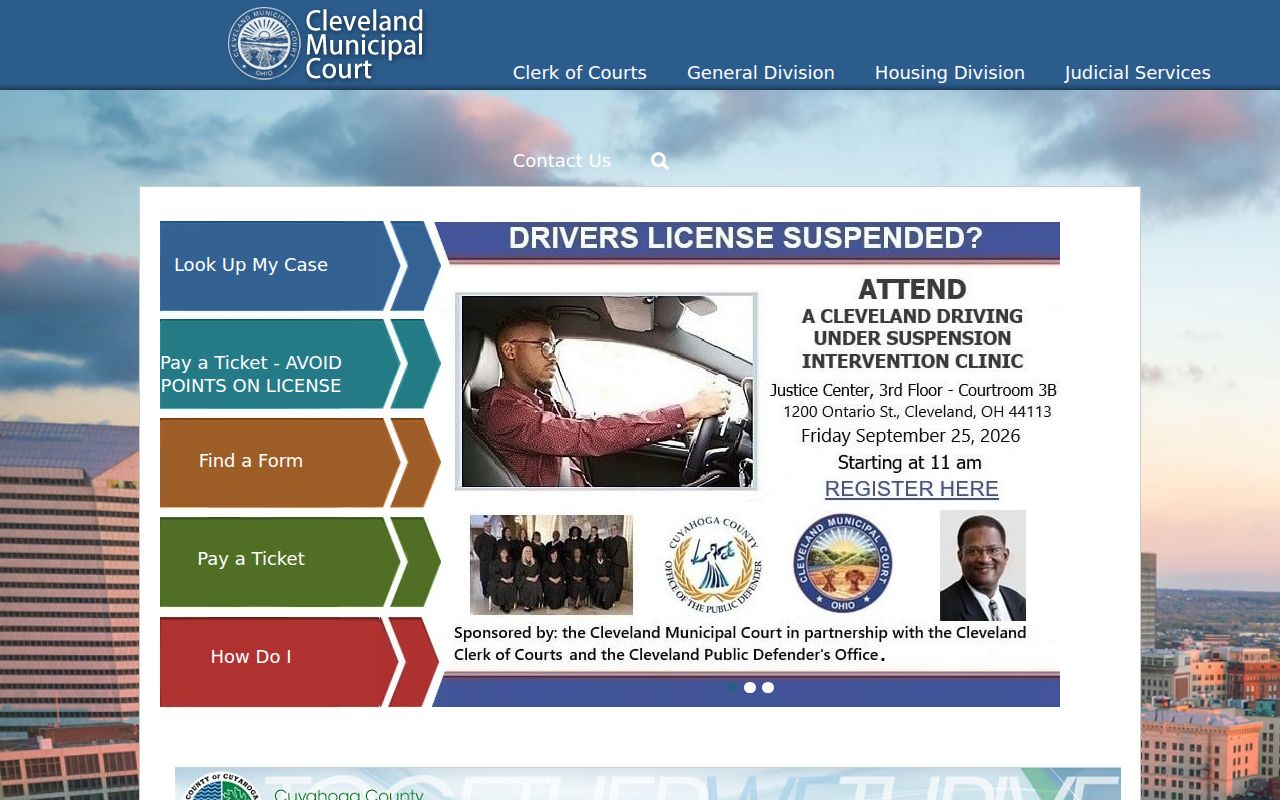
Municipal Court access should not be substituted for a Common Pleas or Probate search because their jurisdictions and files differ.
Cleveland Residents and Vital Copy Routes
The Cleveland Office of Vital Records issues certified birth certificates for anyone born in Ohio and death certificates for Cuyahoga County except Lakewood and Parma. Its order paths are online, telephone, mail, and walk-in. Birth requests use identifying facts such as the full name, date, mother's maiden name, and often the father's name or hospital; death requests use the full name, date, and place of death. A request is for a certificate, not a substitute for present residency.
For historical events, the custodian can change. County Archives directs pre-1909 birth and death research to its own materials, including self-service microfilm for 1849 through 1908. Probate supplies marriage-copy routes. Ohio Revised Code 3705.23 states the general certified-copy rule and exceptions, so date and record type should come before an order.
Review the Cleveland birth and death certificate instructions for the city counter and order paths.
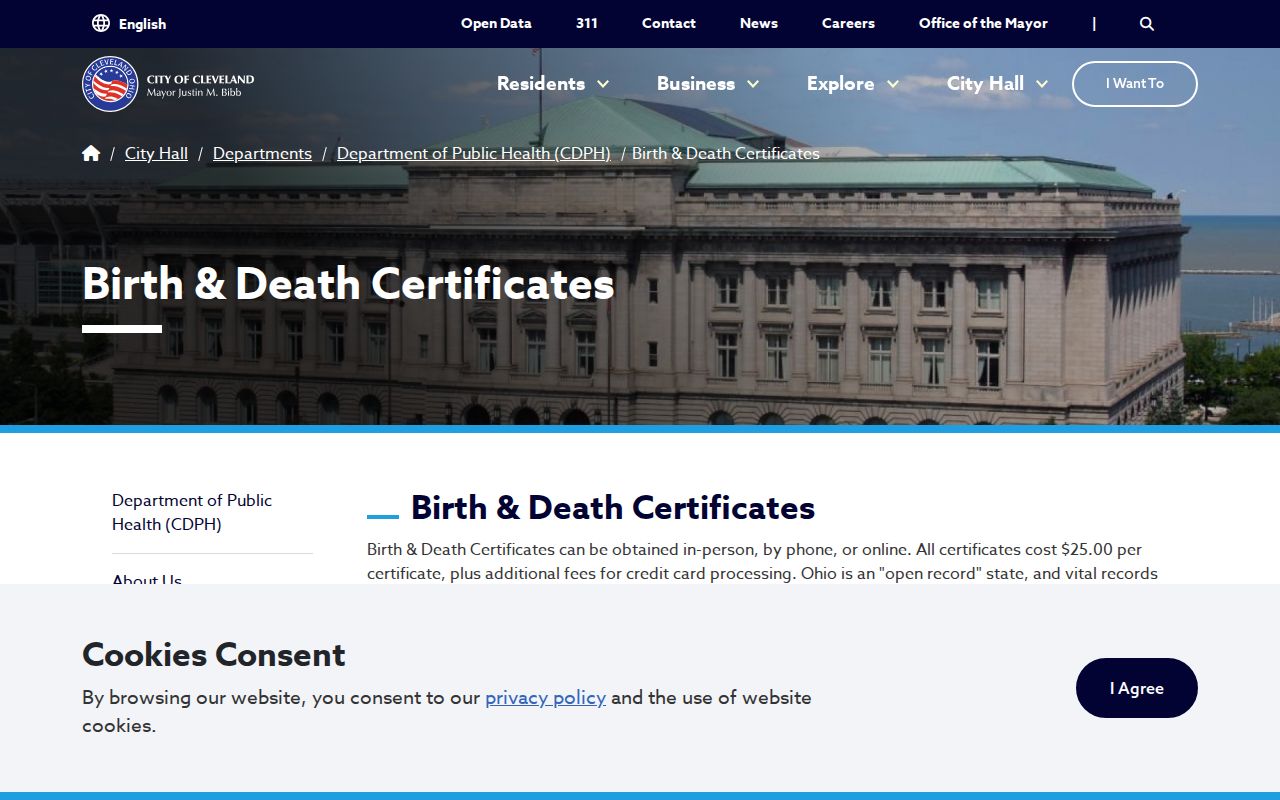
The vital-records page separates Cleveland's current ordering channels from the archive and Probate routes needed for other dates or record types.
Cleveland Resident Records Request Paths
When an online index cannot supply the item, Ohio's Public Records Act, R.C. 149.43, is the written-request fallback. It permits inspection of nonexempt public records during regular hours and copies within a reasonable period. A person need not provide identity or purpose, though an office may explain that optional information would help identify, locate, or deliver the record. A denial must identify its legal authority, and a written request receives a written explanation.
Cuyahoga County's public-records request route asks for the responsible department, delivery choice, and a specific description. The City uses a distinct policy and request process for its records. Asking for the record type, address or parcel, date range, and department produces a cleaner request than asking a broad question about a person.
Use the County public-records request page when an online result needs a department-specific follow-up.
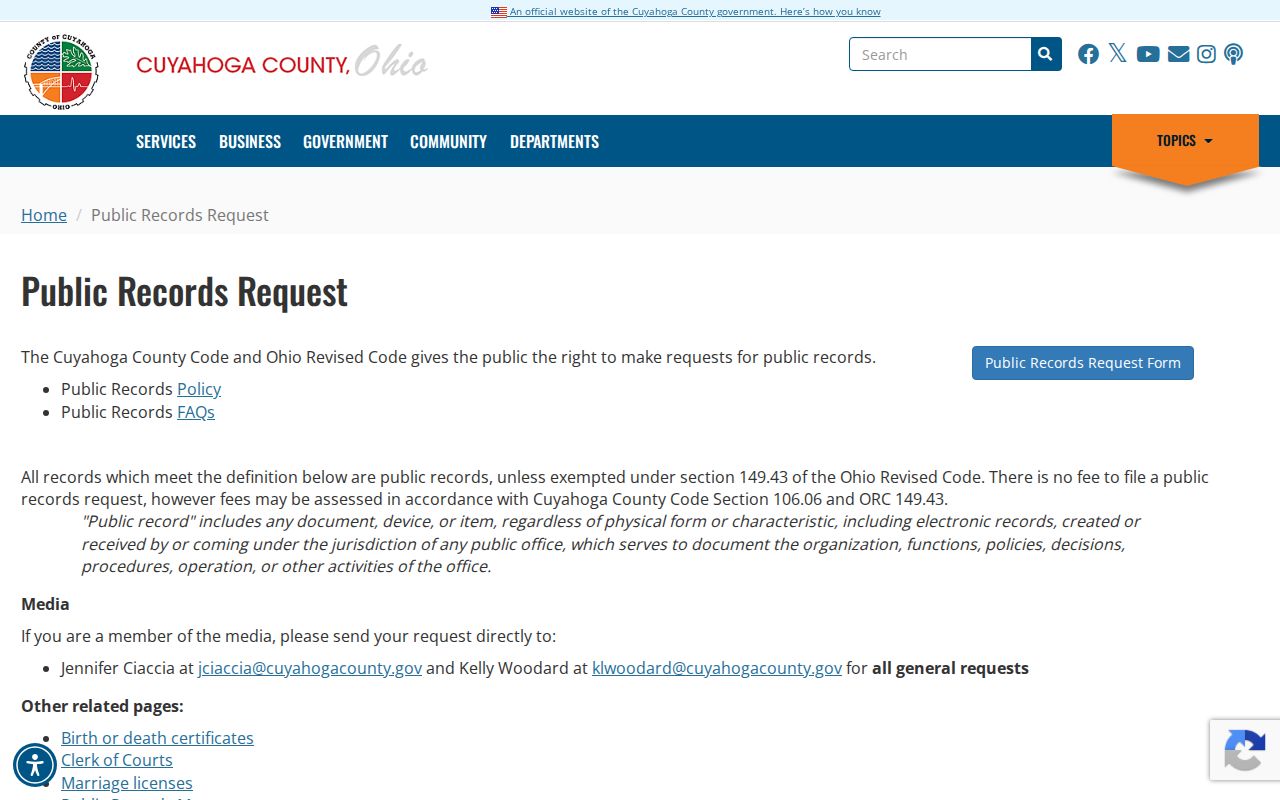
The County route is a practical fallback for a Cleveland residents directory question when the keeper is known but the desired record is not posted online.
For city-held material, consult the City of Cleveland public-records policy.
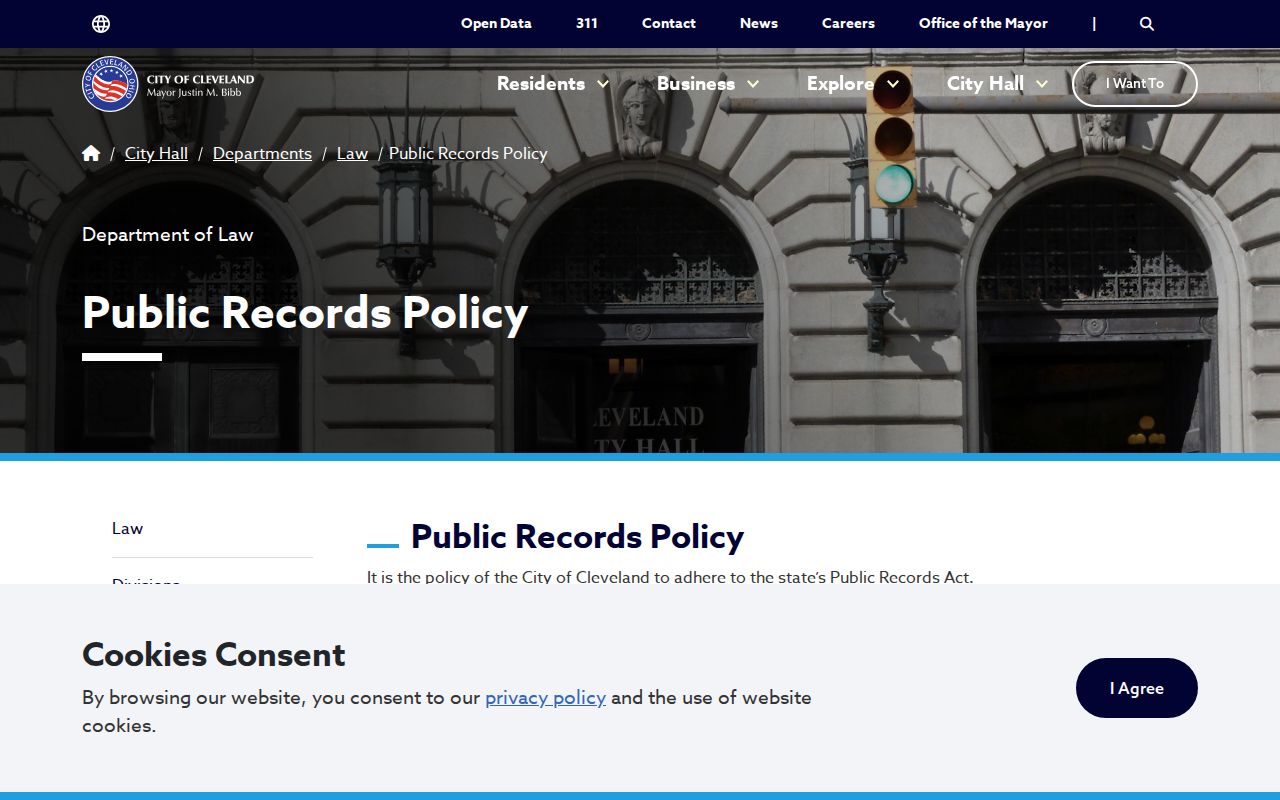
The city policy explains that paper and electronic records can be requested while exemptions and redactions still apply.
Cleveland Resident Privacy Boundaries
A public index can still leave out protected information. Ohio Safe at Home gives qualifying participants a designated address and can affect voter handling and real-property confidentiality. Court systems protect juvenile, adoption, domestic-risk, medical, financial, and other sensitive material. Driver information is also governed by separate federal limits. A missing field or result should be treated as a privacy boundary, not a reason to search around it.
- Parcel
- A county identifier for a piece of land that can connect address, map, tax, and transfer records.
- Index
- A finding tool that points to a record; it is not always the complete document.
- Situs address
- The physical location of the parcel, which may differ from a mailing address.
- Criss-cross directory
- A historical address-based listing used to work from a street location toward a dated household clue.
Cleveland Resident Archives Since 1975
Cuyahoga County Archives was created in June 1975 after historic county materials dating to 1810 had been held in multiple places. The repository began moving poorly stored records and microfilming permanent material. Its catalog reaches beyond an online search with Commissioners' Journals, marriages, naturalization, tax records, probate series, appraisal cards, early births and deaths, and city directories. This is Cleveland's strong counterpoint to a web-only search.
For property work, the Archives guides researchers to bring a street address or parcel number and move through maps, tax records, deeds, directories, census, probate, and newspapers. Original map volumes cover roughly 1860 to 1945, county tax records about 1819 to 1986, and Cleveland-specific maps include 1870, 1880, and 1890. An appointment is required for in-person research. The archive path is especially useful when a street name, number, or legal description has changed.
Historical Cleveland Resident Directories
Historical Cleveland resident directories live across several shelves. Western Reserve Historical Society reports Cleveland and suburb directory coverage from 1837 to 2000. Cleveland Public Library holds city, telephone, criss-cross, Blue Book, news, necrology, and local-history material, while County Archives has city directories from 1837 to 1872, not inclusive. A directory entry is a dated clue that should be checked against the edition's key, map, tax record, or census context.
The 1930 Cleveland directory has alphabetical, street, householder, office, map, buyer, and classified sections. Its street portion can link an address to an edition-specific occupant or householder, but it does not establish a modern household. The full collection methods, gaps, and sample entry are retained on the Cleveland city directory page.
Cleveland's WPA Records Story
In 1936, Cleveland's WPA Historical Records Survey worked with Cleveland Public Library and the County Recorder. It produced a two-volume Cuyahoga archives inventory, created historic-newspaper abstracts in the Annals of Cleveland, and worked on foreign-language newspapers before the project ended in 1942. Unfinished work went to Western Reserve Historical Society and the Ohio Historical Society.
That local story is a practical reminder to pair sources. A contemporary directory may provide a name or address, an earlier index may supply a date range, and a WPA abstract or repository finding aid can reveal where the underlying record belongs. Cleveland's record history is not a claim that every old document has been digitized. It is evidence that the library, county, city, and state routes complement one another.
Cleveland Resident Permit Records Now
Cleveland's construction permitting moved applications, supporting documents, permit downloads, and plan review to a digital workflow on April 13, 2026, while public permit lookup remained available without a login. The City portal exposes General Search, Address, Contact, Application, and Parcel routes. Address fields include direction, street number, street name, street type, unit detail, city parcel number, and optional ZIP criteria.
A permit trail records activity that was applied for, permitted, inspected, or updated in the City system. Cleveland cautions that it cannot prove every alteration because work may not have been reported or permitted. For a paper or plan question, Building & Housing Records Administration, its written-request route, and City Hall support remain part of the access chain. The timely digital change improves the current route without creating a universal historical record.