
Cleveland Previous Residents Through Time
One Cleveland address can appear in records made for different purposes. Recorded deeds trace changes in ownership; tax and map records test the parcel's continuity; directories and census schedules offer dated household clues. The key is not to merge those Cleveland roles. An owner is not automatically an occupant, and a directory entry is not a deed. Save the parcel ID, legal description, document number, date, street form, and locality with each finding. That Cleveland record of the research path makes it possible to check the same property across eras even when a street name or number has changed.
| Source | Years it covers | Where held | What it shows |
|---|---|---|---|
| Cleveland recorded deeds and ownership documents | Circa 1810-present | Cuyahoga County Fiscal Officer, Official Records Search, and Recorder counter | Parties, filing dates, legal descriptions, and document identifiers |
| Cleveland original map volumes | Circa 1860-1945 | Cuyahoga County Archives by appointment | Historic parcel, street, and structure context |
| Cleveland historic tax records | Circa 1819-1986 | Cuyahoga County Archives | Ownership and value cross-checks |
| Cleveland and suburb city directories | 1837-2000 | Western Reserve Historical Society Library | Address-to-named-household snapshots |
| Federal population census for Cleveland | Released under the federal 72-year access rule | National Archives and library genealogy databases | Decennial household context |
| Cleveland city permit history | Online start date not published | Cleveland Permit Portal and Records Administration | Dated recorded work or status at an address |
For a recent Cleveland transfer, begin with the present parcel and its transfer path. For an older Cleveland address, the Archive's maps and tax records may be the first workable source. Directory and census years belong after the address form is settled. Permit history can corroborate recorded work at an address, but Cleveland cautions that a missing permit does not prove work did not occur.
Cleveland Previous Residents and Parcel IDs
Cuyahoga County MyPlace is the current Cleveland address-to-parcel bridge. Select Cleveland, then use its Owner, Parcel, or Address mode to open a property. The record presents General Information, Transfers, Values, Land, Building Information, Building Sketch, Other Improvements, Permits, Property Summary Report, Tax By Year, and a document-list path. MyPlace distinguishes the property situs in Cleveland from a mailing address. The situs is the physical parcel location, while a mailing address is used for correspondence and does not establish that a person lived at the property.
Cuyahoga County Archives property research provides the Cleveland fallback for a parcel whose modern display no longer solves the old address.
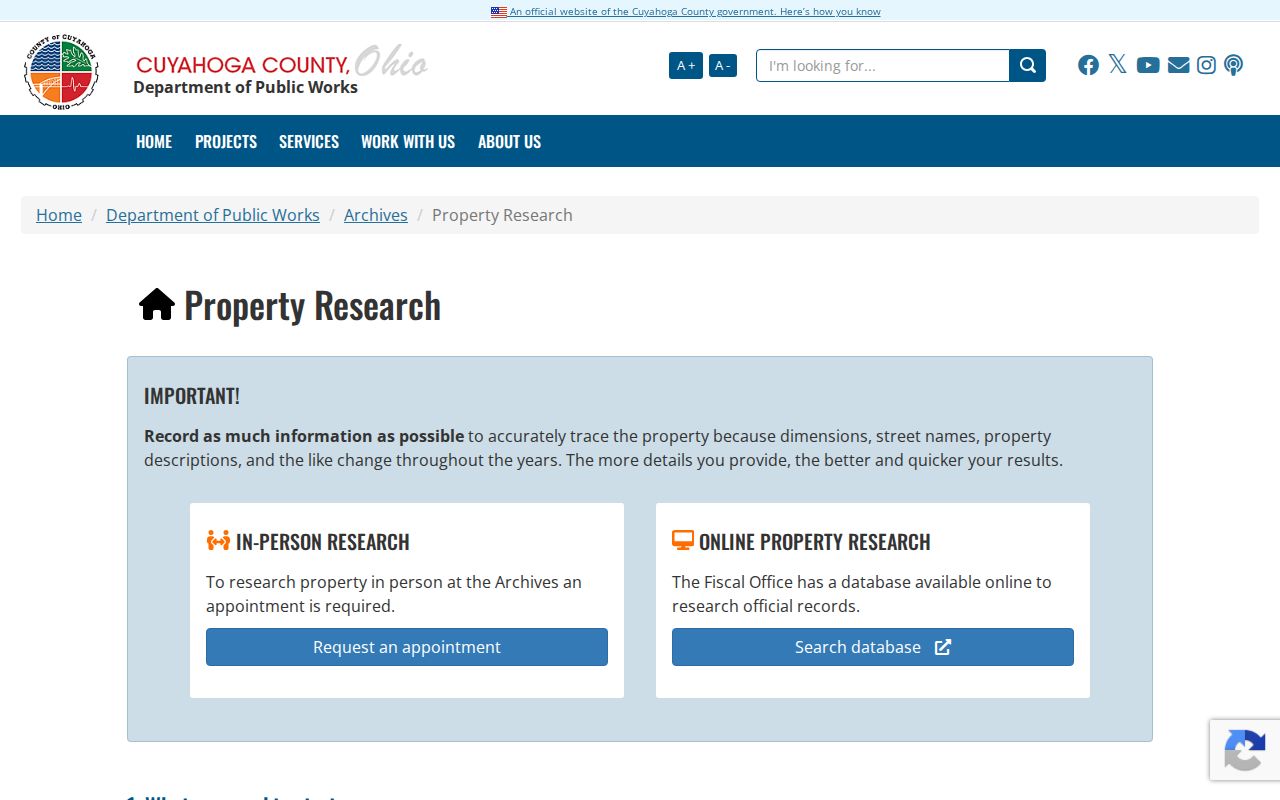
The Cleveland Archives route preserves the address and parcel together, then uses maps, tax duplicates, and deeds to test continuity. The county labels MyPlace geographic information a free public service rather than the official record, so an important Cleveland ownership question belongs in the recorded instrument.
Cuyahoga Deed Chain for Past Residents
The Cuyahoga County Fiscal Officer, Transfer & Recording / Official Records Search states that Cleveland recorded material reaches from 1810 to the present. Its advanced fields include party names, grantor, grantee, recorded and instrument dates, document types, parcel ID, volume and page, property address, legal-description fields, and document number. Cleveland parcel IDs use dashes. The portal can lead to a deed, but the records must be read as ownership evidence, not as a roster of people at the address.
- Open the current parcel in MyPlace and save its parcel ID, situs, transfer clue, and legal description.
- Locate the current transfer or purchase document in Official Records Search using the parcel, party role, date, address, legal description, or document number.
- Record the grantor, grantee, instrument date, recorded date, document number, volume or page if shown, and the legal description.
- Use the seller, normally the grantor on that deed, as a prior grantee search lead while retaining the same property identifiers.
- Repeat backward and test each link against historic maps and tax material. When a description changes or a parcel splits, move to the Recorder counter or County Archives rather than guessing.
- Grantor and grantee
- The grantor transfers an interest in a document; the grantee receives it. A prior owner is commonly found as the earlier deed's grantee.
- Chain of title
- The sequence of recorded transfers linked by the same property identifiers and tested against the supporting record set.
- Legal description
- The land description used in recorded documents. It can survive a change in street number, street name, or parcel layout better than an address alone.
- Parcel ID
- The county key for a mapped lot. Keep its dashes and pair it with the legal description during a backward search.
Cleveland Previous Residents After 1906
Most Cleveland street names and all Cleveland street address numbers changed under a standardized plan in 1906. City Council adopted the numerical system on March 6, and it took effect December 1. Formerly annexed villages had separate systems. An older Cleveland deed, map, or directory may therefore use a number that cannot be found by entering the current street address into a modern portal.
Cleveland Public Library's Old and New Street Numbers property guide is the bridge between those Cleveland systems. Preserve the current address, former address, parcel number, legal description, map book and page, and directory spelling before moving further back. The objective for Cleveland addresses is continuity, not a forced match between two street numbers that only look similar.
Cleveland Archive Maps and Tax Records
The County Archives property guide gives specific source runs for Cleveland. Original Cleveland map volumes are available there for about 1860-1945. The Fiscal Officer Map Room holds later map material for Cleveland from about 1945 forward. Historic Cleveland tax records at the Archives run about 1819-1986, followed by online or Fiscal Officer access from 1987. For Cleveland, the guide calls out map volumes dated 1870, 1880, and 1890, plus atlases. Those dates give a grounded way to test an address that falls outside a current map display.
A small box or outline on a historical Cleveland map indicates that a building stood during the period covered by that map. Find the historic Cleveland owner from the map or atlas, compare tax duplicates, and look for a major valuation change as a construction clue. It is evidence to investigate, not a fixed construction date. Cleveland street names, dimensions, and property descriptions can change, so map and tax material should confirm the deed sequence rather than replace it.
Cleveland Previous Residents in Directory Years
Cleveland recorded transfers do not identify every past household. For the household layer in Cleveland, use a city directory edition for the relevant address and read it as a dated publisher record. Western Reserve Historical Society holds Cleveland, East Side, and West Side suburb directories from 1837-2000. CPL's Cleveland records say that address listings appear at the end of its volumes beginning in 1929. Later Cleveland criss-cross directories add an address-to-listed-telephone path, but none of these sources proves ownership or every member of a household.
A Cleveland historical directory volume in CPL's Digital Gallery shows the kind of alphabetical entry that can start an address trail.
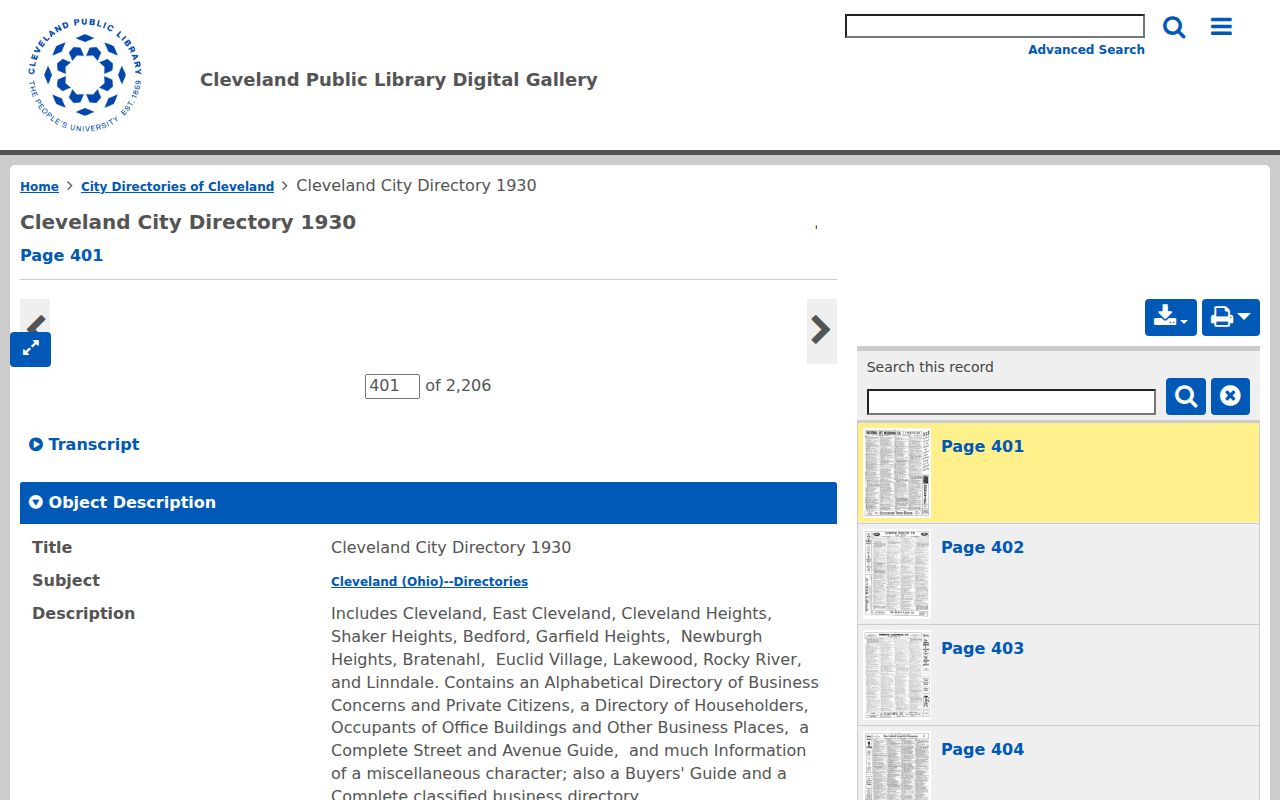
Read the original Cleveland page with the edition's abbreviation key. In the 1930 Cleveland householder list, @ means canvass information indicated that the listed person owned the house. The occupation information belongs in the alphabetical listing, and the mark itself is not a substitute for a recorded deed.
Pairing Cleveland Directory and Census Years
Pair a Cleveland directory's street and locality with the appropriate federal census release instead of treating either Cleveland source as a complete household record. The directory tells what its publisher canvassed in that edition. A census adds a decennial context, but historic locality labels still need care around Cleveland, Ohio City, suburbs, and former annexed places. The Cleveland directory collections themselves are described on the Cleveland City Directory page.
- Resolve the address to the correct pre- or post-1906 form and select an edition that includes the printed locality.
- Capture the name spelling, address, entry type, edition, and page before comparing the next available directory year.
- Use the matching census release to test household composition and preserve the locality printed in that source.
- Compare a change with a tax record, historic map, newspaper notice, probate file, or vital record before assigning a reason for it.
Cleveland criss-cross directories are a useful address check. CPL holds them in print for 1923, 1925, 1926, 1960-93, and 1996-2010, with a narrower microfilm run. They remain Cleveland edition-specific telephone listings, not evidence of a present occupant.
Cleveland Previous Residents and Permit Gaps
Cleveland Construction Permitting states that the public can see Cleveland permit history at a specific address and track status without logging in. MyPlace also has a Permits tab. The Cleveland Records Administration route offers a written-request and telephone fallback for record and plan material. Permit history can date documented work or status at an address, but it cannot prove that every alteration was reported to the city.
For Cleveland endpoint records, a Cuyahoga Probate docket can lead to an estate file and its copy channels. A death certificate request through Cleveland or the appropriate local registrar can establish basic death facts when the requester has the identifying details. These Cleveland custodians have different rules. Use them to corroborate a dated person or transition, not to fill a gap with an unsupported story.
Cleveland Archives and Past Residents
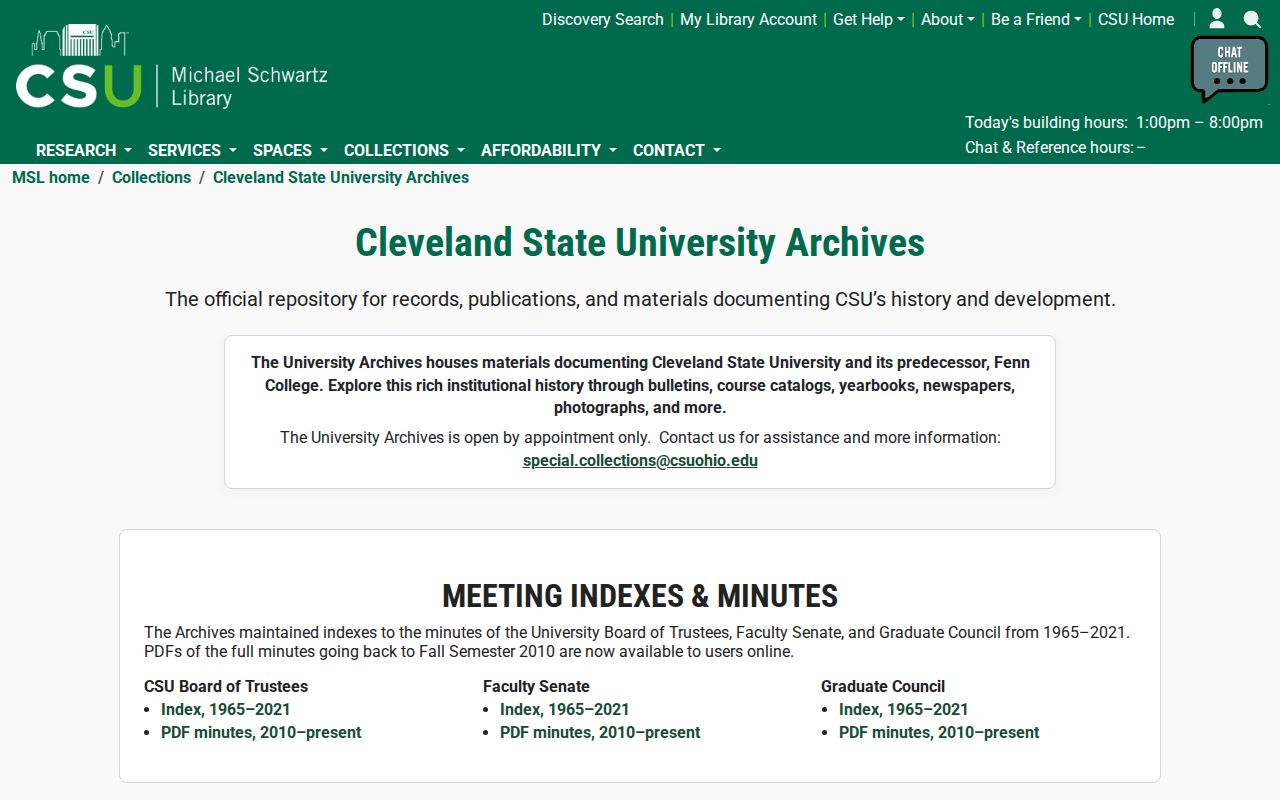
Cleveland State University Archives is an appointment-only Cleveland local-history route with institutional collections, indexes, and selected online minutes. Its Cleveland Memory materials and newspaper context can help place a Cleveland property or name beside the county's map, tax, probate, and directory layers. It is complementary to Cuyahoga County Archives, not a substitute for the Recorder's recorded document or the original directory edition.
Cuyahoga County historical records in Cleveland have moved among offices over time. Cuyahoga County Archives began in 1975 after earlier records had been held in several locations and began microfilming permanent material. That Cleveland preservation history is why an older trail may require the archive, a library collection, and the Recorder counter together.
Cleveland Previous Residents: Proper Boundaries
Cleveland past-resident research is most useful for family history, a property's documented history, heir and estate questions, or personal curiosity. Keep the Cleveland source date and its stated purpose visible. Do not turn a Cleveland parcel owner, mailing address, telephone listing, or one directory line into a claim about a living person's presence. Ohio's Ohio Public Records Act, R.C. 149.43 provides a written-request fallback for nonexempt government records, while court, vital, confidential-address, medical, and other protected material can remain unavailable or redacted.
Lawful personal use. Use Cleveland past-resident records for personal, family, or property history, and never use a record to stalk, harass, or harm another person.
When an office does not deliver an older document online, state the record type, name, date range, address or parcel number, and any known volume, page, or petition number in the request. The County Archives asks for that detail and separates different request types. A careful request is more useful than a broad search for a name alone.