
Cleveland Resident Lookup Records
A resident lookup is a corroboration task, not a single master search. Cuyahoga County MyPlace can connect a recorded owner, parcel, situs address, tax correspondence, and transfer lead. The Fiscal Officer's recorder index can then connect a party to a dated instrument. The Ohio voter tool answers a known-name registration question, and court systems identify parties only within their own cases. Vital and credential records have still narrower purposes. Each source can add a fact, but none proves every person currently at an address.
| Record | What It Confirms | Where | Access |
|---|---|---|---|
| Parcel and transfer record | Recorded owner, parcel, situs, transfer lead | Cuyahoga County MyPlace | Public portal; underlying office record controls |
| Recorded instrument | Party role, date, document, parcel, legal-description link | Official Records Search | Public index, Recorder counter, or public-record request |
| Registration record | Known-name registration, precinct, and polling information | Ohio Voter Search | First name, last name, and county required |
| Court docket or file | Party role, case event, and court connection | Cuyahoga County Clerk Web Docket, Municipal Court, or Probate | Portal, clerk contact, counter, and copy route vary by court |
| Vital or probate record | Known event or estate and marriage matter | Cleveland vital office, Probate, or County Archives | Identifying facts, form, and custodian rules apply |
Begin with the record that fits the question. A property question starts with MyPlace and the recorded document. A known person's registration question belongs in the voter tool. A case clue belongs in the correct court division. Save the source URL and date checked with each result. Note: A property owner or mailing address is not proof of present physical occupancy.
Cleveland Resident Lookup Map Proof
Same-name errors shrink when independent details are kept together. Record the exact and variant name, middle initial or former name, address or parcel, date range, record type, party role, and source date. A usable match should converge across custodians, such as a parcel transfer and a dated recorder instrument, or a Probate case number with a party role and address. This creates a dependable trail when names recur across sources. A clerk can help locate a specific filing, but an office should not be expected to choose among ambiguous people with the same name.
The distinction between discovery and proof matters in Cleveland. MyPlace's map and parcel display are a public-service layer, while the Fiscal Officer's recorded instrument is the supporting official evidence. That contrast is especially useful when a record has changed or a mailing address differs from the parcel situs. For an older named listing, the historical volumes belong with the Cleveland city directory collections; compare that dated entry with a present record instead of treating it as current.
Cleveland Resident Court Dockets
Cuyahoga County Clerk Web Docket is the route for Common Pleas civil and domestic matters, criminal cases, foreclosure, submitted e-filed complaints, and Eighth District appeals. Cleveland Municipal Court uses a separate case-information system. Probate has its own docket for estates, trusts, guardianships, adoptions, marriage matters, and related cases. Select the court by subject first. A court hit is an index to a file, not a conclusion about a person.
The Domestic Relations name calendar illustrates a narrow name tool: it asks for first name, middle initial, and last name, with at least three characters from the first and last or company name. It directs users to the Clerk docket for the complete record. The Clerk says its in-person official record is the item to rely on for current accuracy, and domestic-violence and civil stalking-protection matters are not available on the internet.
A captured view of the Domestic Relations calendar shows why a name result needs a court-specific follow-up.
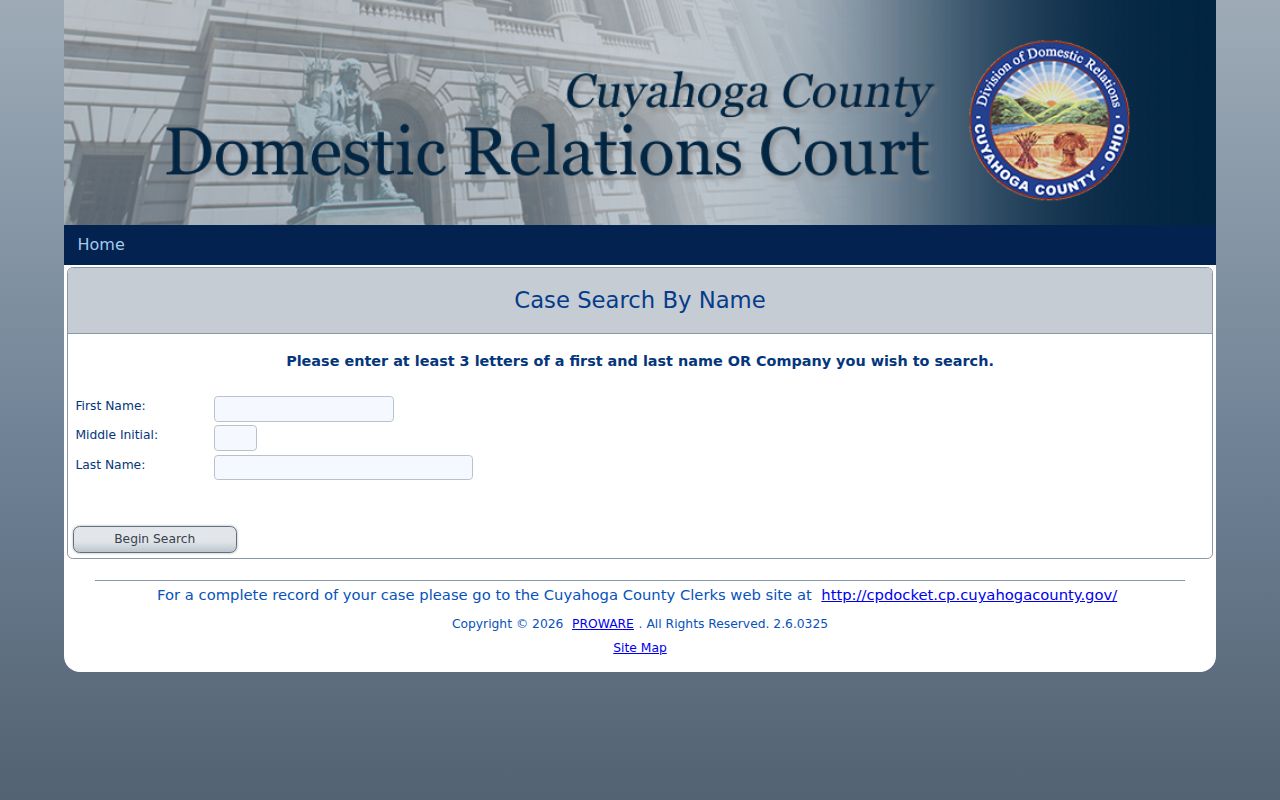
Use the calendar only to identify a properly scoped court lead, then preserve the case number, division, title, party role, filing date, and status date before requesting a record.
Cleveland Resident Probate Results
For an estate or marriage question, the Cuyahoga Probate docket has case and party paths. Its confirmed fields include case year, category, and number, plus person or company, company name, suffix, party role, and case filters. A result can show a name, address, role, alias, case title and type, filing date, judge, status, and status date. The court cautions that electronic data can be incomplete or inaccurate, so use the case number for a copy request.
| Identity | Name, address, role, and alias distinguish a party from a shared name. |
|---|---|
| Case placement | Case year, category, number, title, and type identify the proceeding. |
| Status trail | Filing date, judge, status, and status date lead to the Docket, Events, Parties, Requirements, and Service tabs. |
| Copy path | Regular, certified, and full-case copies use the court's online, mail, or in-person process. |
The Probate party-search screen is a useful view of the result structure.
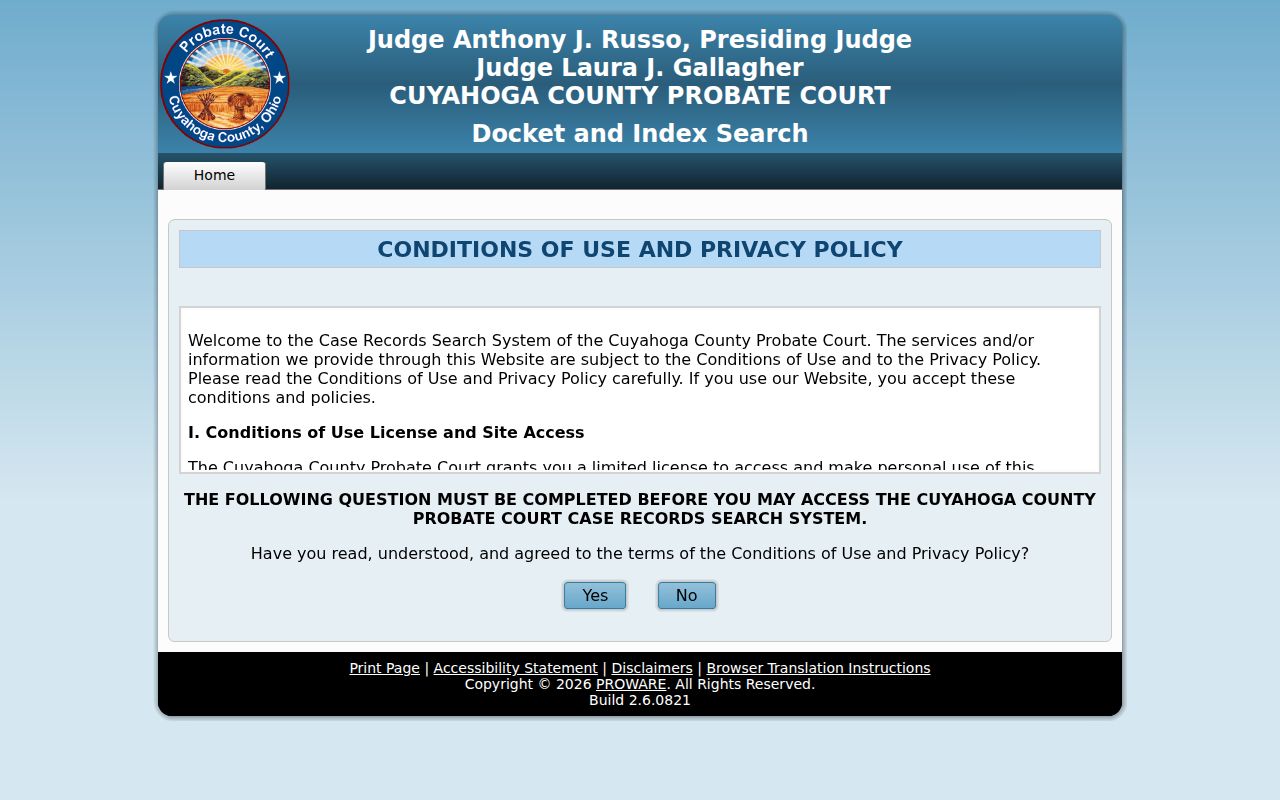
Estate parties should not be labeled as heirs without the underlying court record and its stated relationship or disposition.
Verifying a Cleveland Resident
Use a short sequence to anchor one person without overstating any one result. First compare the known name to a property owner or a voter result. Then test the matching address, party role, date, and case type in a relevant court search. A known vital event can corroborate an already identified person, but it is not a discovery tool for everyone who shares a name. The final step is the official copy from the office that keeps it.
- Search MyPlace by owner, parcel, or address when a property connection is known. Record the parcel number and situs separately from the mailing field.
- Use the Recorder's party, date, address, parcel, legal-description, or document-number path to confirm a dated instrument.
- Run the known first name, last name, and Cuyahoga County through Ohio Voter Search, then compare the limited result with independent details.
- Check the correct court, preserve the case number and party role, and request a custodian copy when a decision requires it.
- Docket
- A court's running list of filings, events, and case activity. It is not always the full court file.
- Index and image
- An index points to a record through fields such as name, date, or number. An image is the displayed document or court material, when the custodian makes it available.
- Certified copy
- A copy issued by the custodian with its certification, used when an ordinary web display is not enough.
Cleveland Resident Voter Confirmation
Ohio Voter Search requires a first name, last name, and county. It confirms registration and provides precinct and polling information. It is not an address-only directory and should not be used as a street roster. Try a derivative first name, former last name, or prior Ohio county only when those are already known. If a result needs correction, the Cuyahoga County Board of Elections handles the record rather than a third party.
The DATA Act voter archive is different from the individual lookup. It distributes dated county registration snapshots under Ohio Public Records Act, R.C. 149.43, with county and date choices. Those files are snapshots, not a statement of current status, and sensitive identifiers, contact data, confidential voters, and protected addresses remain outside public release. Note: Preserve the archive date whenever a historical voter file is used.
Cleveland Resident Credential Checks
A credential or business filing can confirm a narrow official association, not residence. Ohio eLicense Verification uses last name, first initial, and board, or a complete license number. Its detail view can show name, status, board, credential type and number, and key dates. Ohio's entity and UCC systems likewise lead to a filing record, where statutory-agent or debtor information has a defined filing role.
The eLicense verification screen shows the separate criteria used for a credential check.
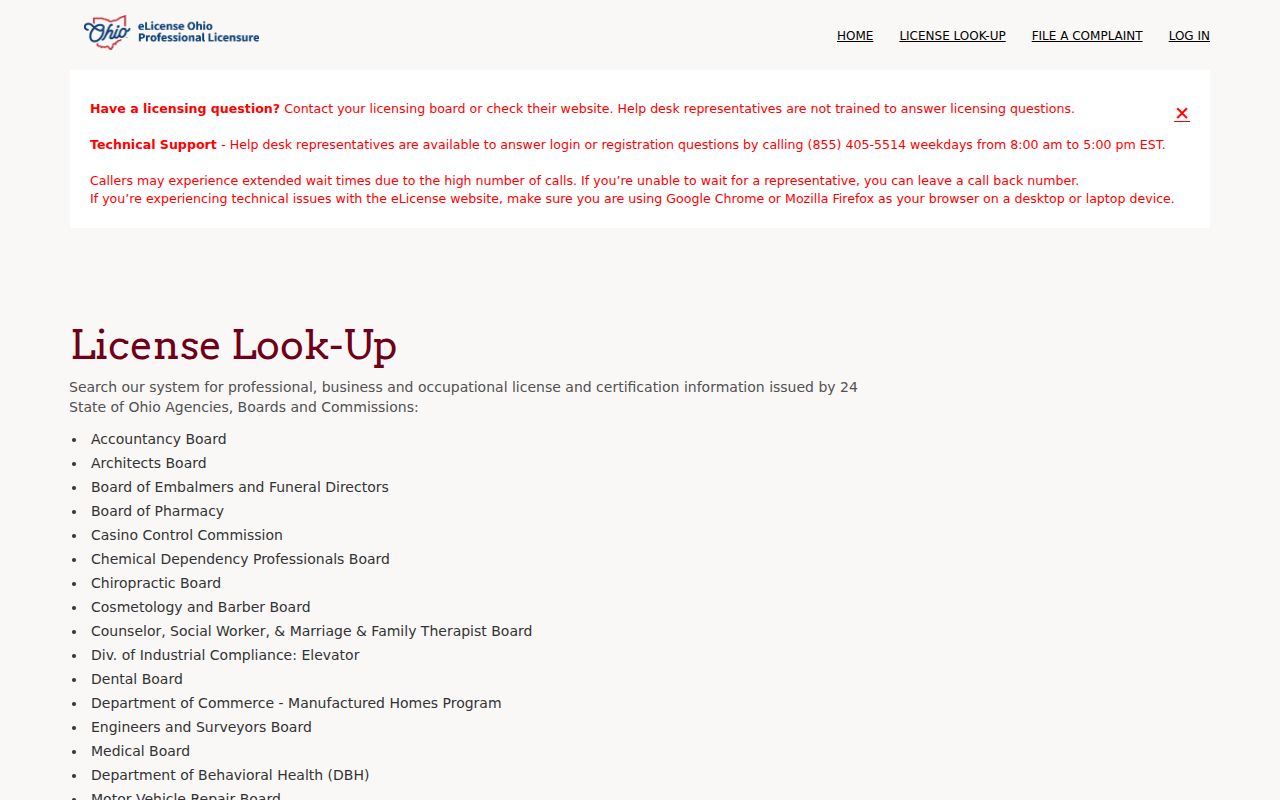
Match a full name with the board and credential number before relying on a result, then contact the issuing board for a correction or record question.
Cleveland Resident Vital Requests
The Cleveland Office of Vital Records issues certified birth certificates for people born in Ohio and death certificates for Cuyahoga County except Lakewood and Parma. Its process asks for identifying facts such as full name and date, plus record-specific details. It offers online, telephone, mail, and walk-in channels. Probate supplies marriage-copy paths. Older births and deaths may belong with County Archives microfilm or its request route, where a record type, surname, date, and any volume or page detail make the request more workable.
When a portal does not supply the needed nonexempt record, Ohio Public Records Act, R.C. 149.43 provides a written-request fallback. The Cuyahoga County request form does not require identity or purpose, but a specific description helps the responsible department locate the material. Inspection is generally free, while copy and delivery charges follow the applicable office rule. A denial should state its legal authority, and nonexempt portions should be released with clear redactions.
Cleveland Resident Lookup Privacy Limits
Ohio public access has real boundaries. Safe at Home gives qualifying participants a designated address for protected governmental uses and includes confidential voter handling. R.C. 149.45 provides a route to request web redaction of specified sensitive information, while R.C. 317.082 addresses sensitive information in recorder instruments. Court remote-access rules can also withhold protected identifiers, medical material, juvenile records, adoption material, and other restricted categories.
A missing online record is not proof that no record exists, and a public result can still omit protected fields. Take an accuracy issue to the custodian: the Fiscal Officer for property material, the Clerk or court for case material, City Records Administration for permits, and the Board of Elections for voter questions. Preserve the document or case reference, the disputed data, and the reply.
Lawful use. Use Cleveland resident records for personal, historical, estate, civic, or safety-related research. Do not use any result to stalk, harass, or harm a person.