
Finding Cleveland Residents by Record Type
Different questions pull a Cleveland residents directory search toward different sources. A present address belongs first in Cuyahoga County MyPlace. There an owner, parcel, or address search opens the parcel record. A known name instead points to the Ohio voter tool, a court party index, a vital-record copy, or a historical directory. Each record captures one connection to Cleveland, never a whole household.
Start from the sturdiest fact you hold. Keep the parcel number with the address. Keep a case number with a court result. Retain the directory year beside any historical listing. Why? A property owner's mailing address can differ from the physical situs, and an indexed party may be a former owner or a litigant. A Cleveland residents directory search therefore works best as a short chain of independent records, each one checking the last.
- Search MyPlace by address, owner, or parcel to establish the present property record and retain the parcel number.
- Use Ohio Voter Search for a known first name, last name, and county when registration confirmation is the question.
- Check the Official Records Search for an instrument tied to the parcel, address, or named party.
- For a past household, compare a dated city directory with maps, tax material, and census records held by local repositories.
- When the needed item is absent online, ask the named custodian for it through the correct counter, copy route, or public-records request.
Cleveland Residents and Record Custodians
Cleveland is the Cuyahoga County seat. That means many resident leads begin with county custody rather than city custody. Transfer & Recording maintains the deed and parcel side. MyPlace supplies the current parcel view, and the Board of Elections handles local election records. Each office answers a different question. For following one address across a full block or street, the Cleveland street directory route is the place to start.
Fiscal Officer, Transfer & Recording
2079 East Ninth Street, fourth floor
Cleveland, OH 44115
216-443-2060
Cuyahoga County Property Data
County parcel, transfer, value, and tax records
Cleveland and Cuyahoga County
Use the property portal for a parcel path
Cleveland Residents Through MyPlace
MyPlace is the County's address-facing tool. Choose Cleveland first. Then pick Owner, Parcel, or Address before opening the parcel record. Visible paths include General Information, Transfers, Values, Land, Building Information, Permits, Tax By Year, a document list, map view, and address CSV download. Map view and a CSV download are included too. That spread makes it a strong Cleveland residents directory start. One caution applies: the County states that the geographic display is not the controlling official record.
| MyPlace path | Useful Cleveland record clue |
|---|---|
| City and Address | Starts an address-specific parcel search. |
| Owner | Finds a parcel associated with a recorded owner name. |
| Parcel | Preserves the county identifier that links property materials. |
| Transfers and document list | Points onward to the ownership and recorded-document trail. |
See the MyPlace property-search screen before starting a parcel search.
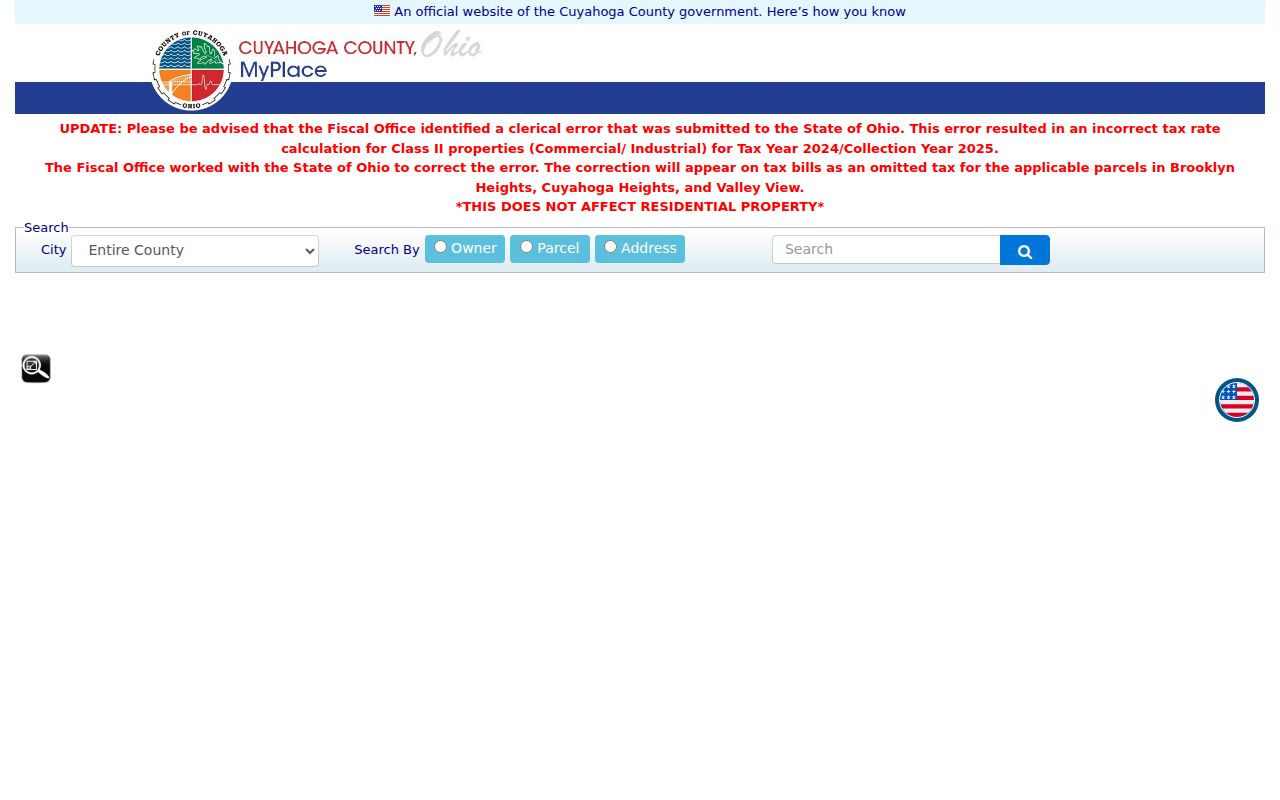
The MyPlace screen shows a simple lesson. A physical address and the county parcel number belong together whenever a Cleveland residents directory search moves on to deeds or archive material.
Cleveland Resident Election Confirmation
Ohio's official voter lookup is useful once a name is already known. Enter first name, last name, and county. It confirms registration with precinct and polling information. The tool is not an address-browse roster. The deeper official option is the Secretary of State's DATA Act voter archive, which publishes daily county snapshots for at least 22 months under Ohio Revised Code 149.43 and carries its own date and county limits.
The Cuyahoga Board of Elections also offers an office route. Its public-records policy covers the same records. Election records carry protected fields and confidential-participant rules. A missing result proves nothing. Someone can still live in Cleveland. Use the tool to test a known-name question, then preserve the date checked and any precinct context instead of treating the result as a current household list.
Note: Cleveland voter information is one corroborating record, not proof that every person at an address is registered or publicly listed.
Current Cleveland Residents Directory Sources
Every current directory-like record in Cleveland stands for one narrow role. A parcel record covers ownership and property administration. A recorder index lists parties to recorded filings. An election tool confirms one name's registration. Libraries, archives, and community organizations offer other public routes, though none of them works as a universal resident list.
| Cleveland source | Connection shown | Custodian | Access path |
|---|---|---|---|
| MyPlace property record | Parcel, owner, transfers, values, and tax paths | Cuyahoga County Fiscal Officer | Public online portal |
| Ohio Voter Search | Known-name registration, precinct, and polling information | Ohio Secretary of State | Name plus county lookup |
| Official Records Search | Grantor, grantee, document, parcel, address, or legal-description trail | Transfer & Recording | Public index and office route |
| Cleveland permit history | Documented permit or violation activity at an address | Building & Housing | Accela, counter, or request |
| CDC contact directory | Community organization contacts by service area | City GIS and Cleveland Neighborhood Progress | Public organization directory |
One person, one question. A focused Cleveland resident lookup compares names, dates, court divisions, and official copies instead of leaning on a single index.
Cleveland Residents in Recorded Documents
Recorded documents in Cuyahoga County are searchable from 1810 to the present, per the Fiscal Officer. Official Records Search accepts party names, grantor, grantee, recorded and instrument date ranges, document type, document number, parcel ID, volume and page, property address, and legal-description fields, plus image-text searching. Enter parcel IDs with dashes. A deed or lien names parties to a filing. It does not name everyone who lived there.
The quick search offers index-only and Index & Full Text OCR scopes. In index-only mode, terms are searched individually. In OCR mode they run as a phrase. Start with the known parcel or recorded party. Save the document number. For an important ownership conclusion, verify through the recorded instrument or the fourth-floor office. The free Property Alert service can monitor a name, entity, keyword, or single document, though the County warns it is not title assurance.
| Official Records field | Input | How it narrows a Cleveland search |
|---|---|---|
| Party Names, Grantor, or Grantee | Last name, then first name | Finds a named party in a recorded filing. |
| Recorded or instrument date | MM/DD/YYYY range | Limits a result to a known ownership period. |
| Parcel ID | Include dashes | Connects an instrument to the county property trail. |
| Property address | Text field | Provides an address-index route when a document is known. |
| Document image | Phrase field | Uses the portal's OCR image-search path. |
Open the Cuyahoga Official Records Search to see the public quick-search controls.
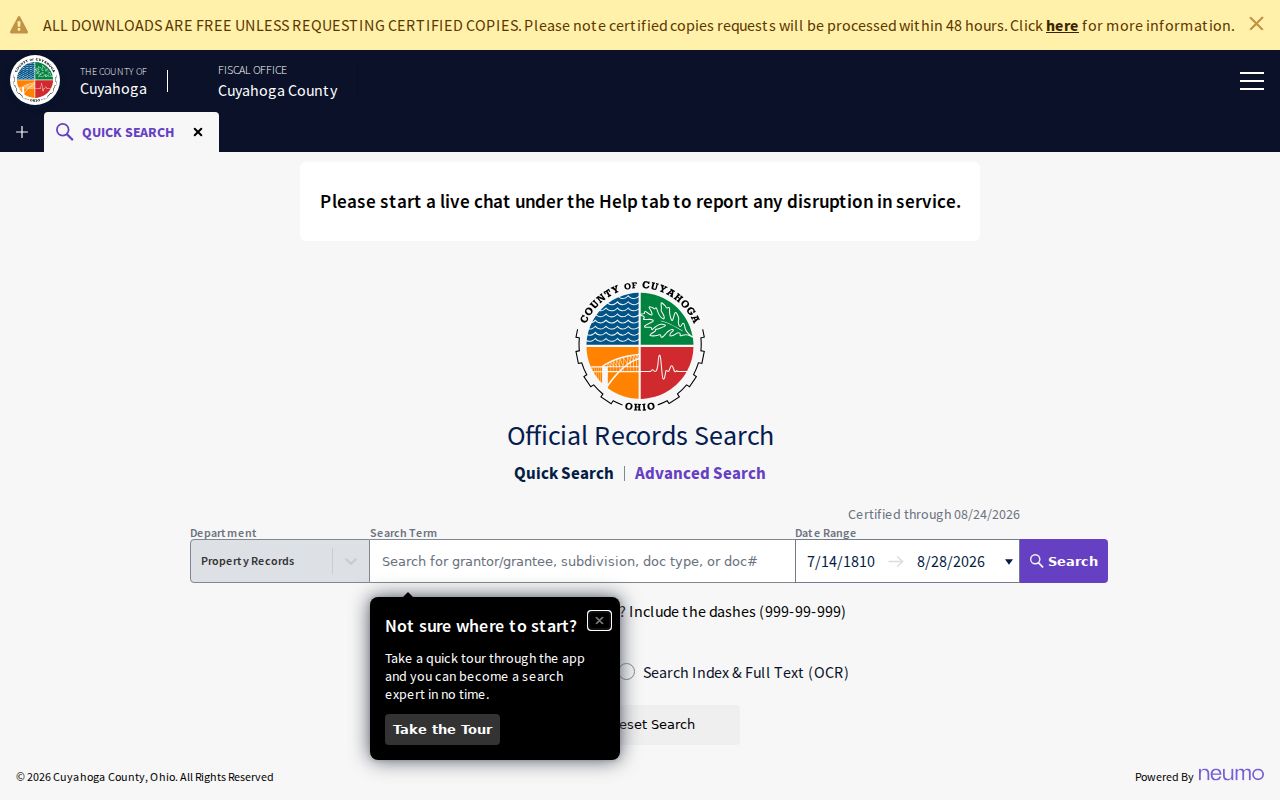
The recorded-document interface shows its fields plainly. Those fields turn a Cleveland residents directory property lead into a checkable instrument trail.
Cleveland Resident Names in Court Indexes
Cuyahoga County runs its courts as separate systems. The Clerk Web Docket handles Common Pleas matters. These include civil, domestic, criminal, foreclosure, e-filed complaint, and appellate cases. Cleveland Municipal Court keeps its own case-information system. Probate maintains a separate docket for estates, trusts, guardianships, adoptions, and marriage files. A shared name in a court result is only a lead. Match the division, case number, and party role. Check the filing date and status too, before treating it as your Cleveland resident.
Remote access carries real limits. Domestic Violence and Civil Stalking Protection Order cases stay off the Common Pleas internet path. Probate warns that its electronic data can be incomplete or inaccurate. Domestic Relations restricts many remote documents. When a court record matters, verify it at the clerk counter or through a court copy route.
The Cuyahoga Clerk Web Docket displays the separate Common Pleas search categories side by side.
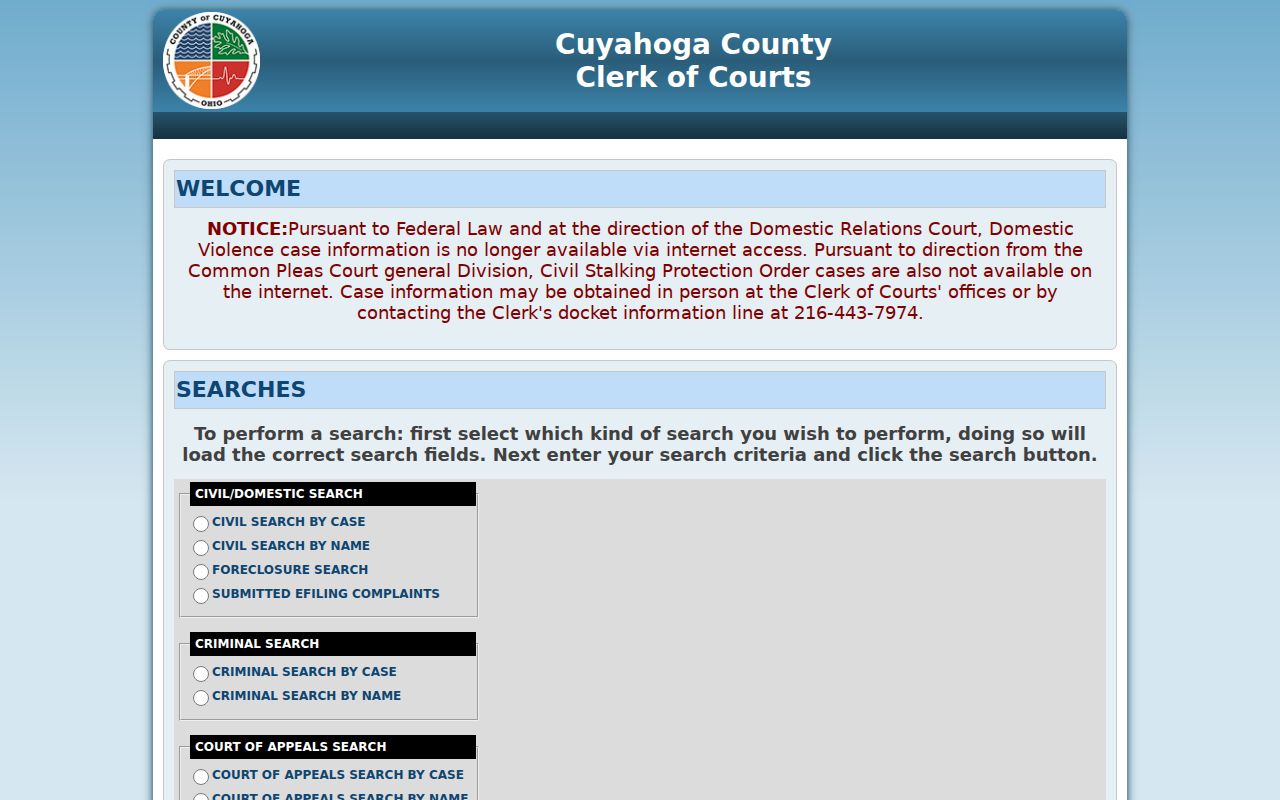
The category screen shows why a Cleveland residents directory name search must start with the right court division.
The Cleveland Municipal Court offers its own separate case-information route.
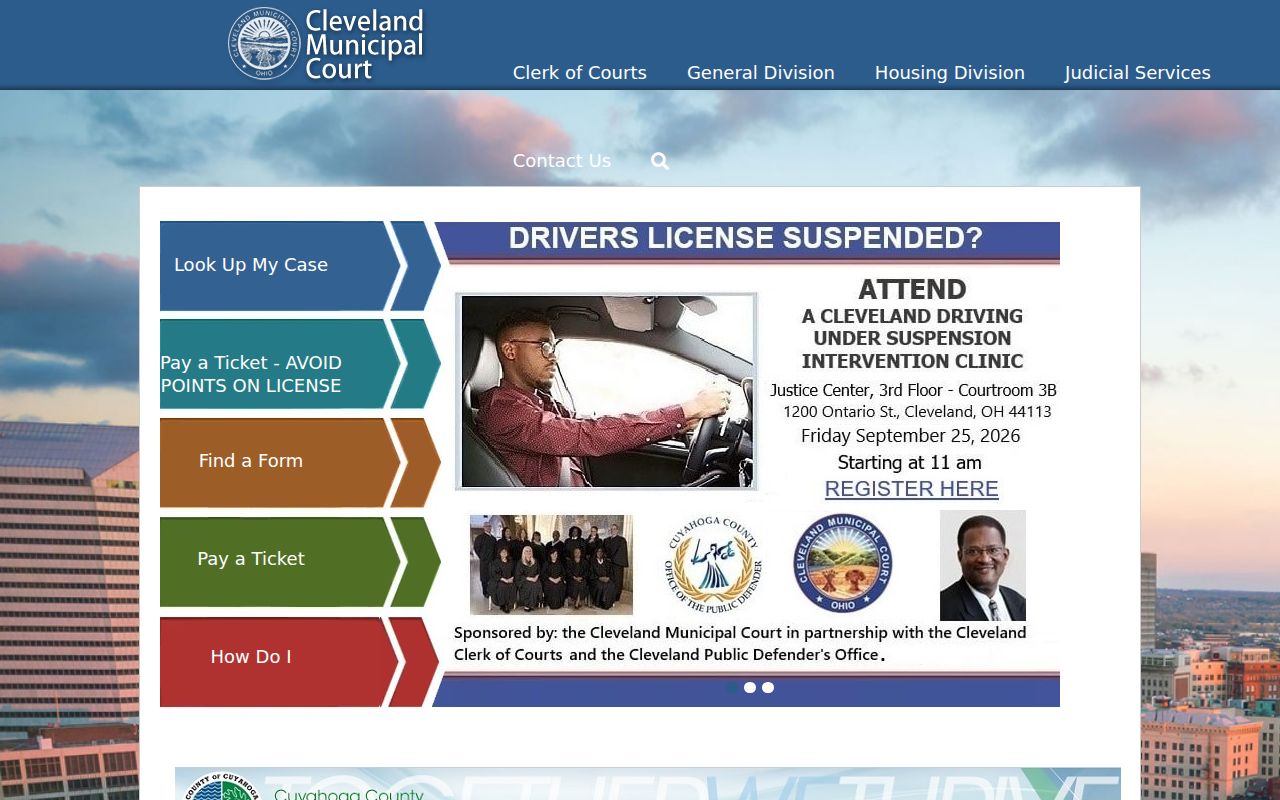
Do not stop at Municipal Court. Its jurisdiction and files differ from Common Pleas and Probate, so a full Cleveland resident lookup should touch each division with its own records.
Cleveland Residents and Vital Copy Routes
The Cleveland Office of Vital Records issues certified birth certificates for anyone born in Ohio. It also handles death certificates covering Cuyahoga County, apart from Lakewood and Parma. Orders go through four paths: online, telephone, mail, and walk-in. Birth requests rely on details like the full name, date, and mother's maiden name. They often include the father's name or hospital. Death requests need the full name, date, and place of death. A certificate proves an event, not current residency.
Historical events can shift the custodian. County Archives points pre-1909 birth and death research to its own holdings. That includes self-service microfilm covering 1849 through 1908. Probate handles marriage copies. Ohio Revised Code 3705.23 sets the general certified-copy rule and its exceptions. Confirm the date and record type before ordering.
Check the Cleveland birth and death certificate instructions for counter service and ordering.
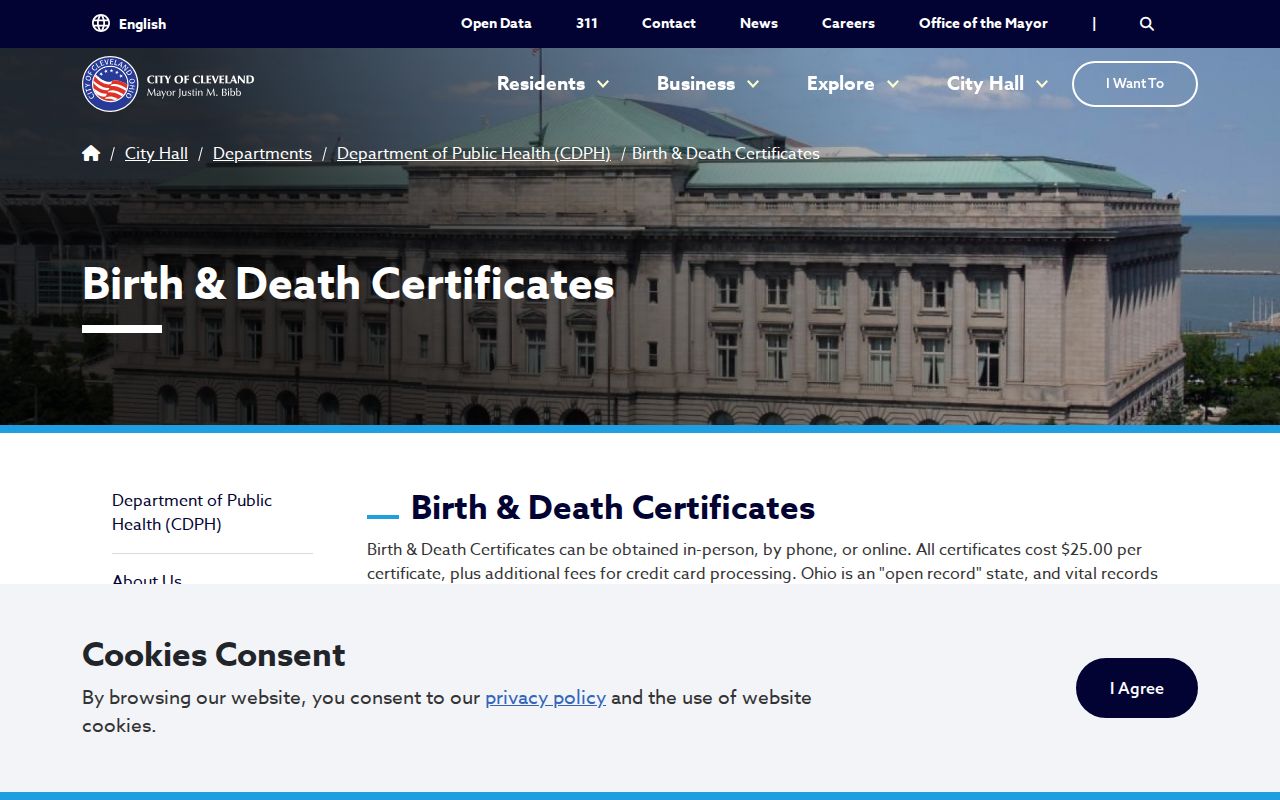
The vital-records page divides Cleveland's current ordering channels from the archive and Probate routes that older dates or other record types require.
Cleveland Resident Records Request Paths
When an online index cannot deliver the item, Ohio's Public Records Act, R.C. 149.43, is the written-request fallback. It guarantees inspection of nonexempt public records during regular hours. It also guarantees copies within a reasonable period. No identity or purpose is required. An office may still note that optional details would help locate or deliver the record. A denial must cite its legal authority, and any written request earns a written explanation.
The Cuyahoga County's public-records request route asks for the responsible department. It also asks for a delivery choice and a specific description. The City runs a distinct policy and request process for its records. Naming the record type, address or parcel, date range, and department produces a cleaner request. A broad question about a person serves you worse.
Use the County public-records request page whenever an online result needs a department-specific follow-up.
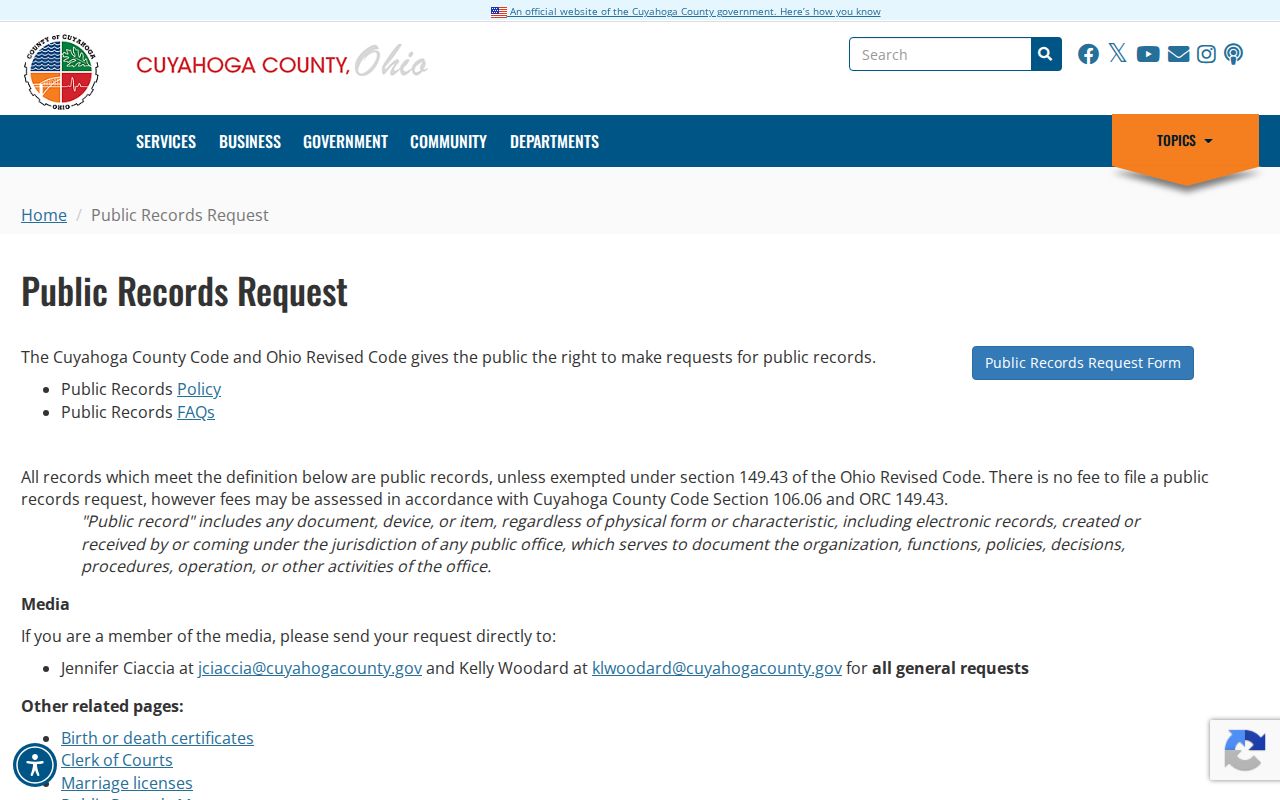
The county route works well as a fallback for a Cleveland residents directory question when the keeper is known but the record itself never reached a website. Sometimes the records office simply keeps paper files, and a written request is the only path.
For city-held material, consult the City of Cleveland public-records policy.
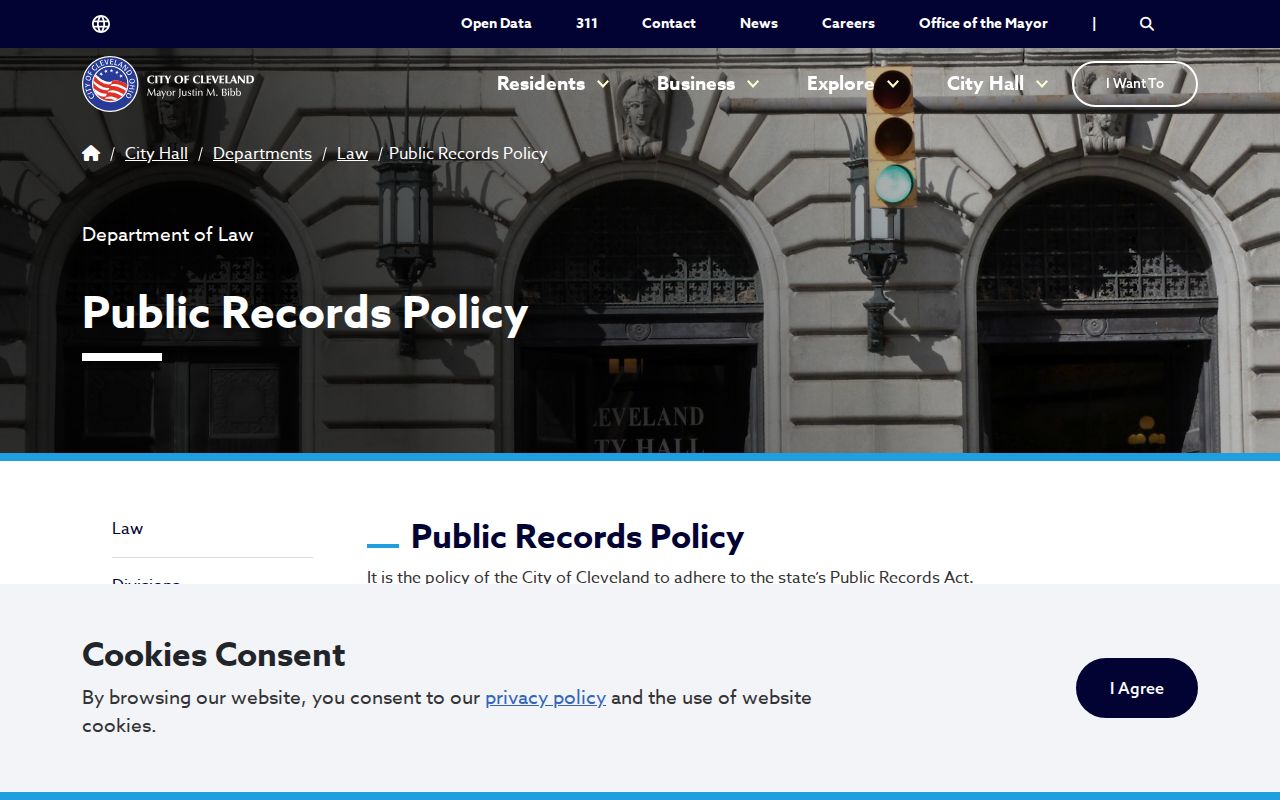
The city policy allows requests for both paper and electronic records, while exemptions and redactions still apply.
Cleveland Resident Privacy Boundaries
A public index can still withhold protected information. Ohio Safe at Home gives qualifying participants a designated address. It can also affect voter handling and real-property confidentiality. Court systems shield juvenile, adoption, domestic-risk, medical, and financial material. Driver information sits under separate federal limits. A missing field is a privacy boundary, not a puzzle to work around.
- Parcel
- A county identifier for a piece of land that can connect address, map, tax, and transfer records.
- Index
- A finding tool that points to a record; it is not always the complete document.
- Situs address
- The physical location of the parcel, which may differ from a mailing address.
- Criss-cross directory
- A historical address-based listing used to work from a street location toward a dated household clue.
Cleveland Resident Archives Since 1975
Cuyahoga County Archives was created in June 1975, after historic county materials dating to 1810 had been scattered across multiple places. The repository began moving poorly stored records and microfilming permanent material. Its catalog reaches past any online search. Holdings include Commissioners' Journals, marriages, naturalization, tax records, probate series, appraisal cards, early births and deaths, and city directories. That depth makes the Archives Cleveland's strong counterpoint to a web-only residents directory.
For property work, archivists direct researchers to bring a street address or parcel number and trace it through maps, tax records, deeds, directories, census, probate, and newspapers. Original map volumes span roughly 1860 to 1945. County tax records run about 1819 to 1986. Cleveland-specific maps cover 1870, 1880, and 1890. An appointment is required for in-person research. The archive path pays off when a street name, number, or legal description has changed.
Historical Cleveland Resident Directories
Old Cleveland residents directory volumes sit in more than one place. Western Reserve Historical Society covers Cleveland and its suburbs from 1837 through 2000. It is a remarkable span. Cleveland Public Library adds telephone books, criss-cross directories, and the Blue Book. It also holds necrology files and local-history material. The County Archives holds city directories from 1837 to 1872, though the set is incomplete. Every entry is a dated clue. Check it against the edition's key, its map, a tax record, or census context. Do that before trusting it.
The 1930 Cleveland directory shows how rich one volume can be. It packs alphabetical, street, householder, office, map, buyer, and classified sections between its covers. The street portion ties an address to that edition's occupant or householder. But it proves nothing about a modern household. Methods, gaps, and a sample entry appear on the Cleveland city directory page.
Cleveland's WPA Records Story
Cleveland's WPA story began in 1936. The Historical Records Survey joined forces with Cleveland Public Library and the County Recorder. Its workers built a two-volume inventory of Cuyahoga archives. They also compiled historic-newspaper abstracts for the Annals of Cleveland. The survey also tackled foreign-language newspapers before funding dried up in 1942. Unfinished projects landed at Western Reserve Historical Society and the Ohio Historical Society.
The lesson for anyone tracing past residents of Cleveland is simple: pair your sources. A contemporary directory gives a name or address. An earlier index supplies a date range. A WPA abstract or a repository finding aid can show where the underlying record belongs. Cleveland's record history is not a promise that everything is digitized. It is proof that library, county, city, and state routes each carry a piece.
Cleveland Resident Permit Records Now
Cleveland moved construction permitting into a digital workflow on April 13, 2026. Applications, supporting documents, permit downloads, and plan review all shifted at once. Public permit lookup still works without a login. The City portal offers General Search, Address, Contact, Application, and Parcel routes. Address fields capture direction, street number, street name, street type, unit detail, city parcel number, and an optional ZIP code directory criterion.
What does a permit trail prove? It shows activity that was applied for, permitted, inspected, or updated in the City system. Cleveland itself cautions that not every alteration appears, since some work goes unreported or unpermitted. Paper and plan questions still run through Building & Housing Records Administration, its written-request route, and City Hall support. The digital switch improves today's access. It does not create a universal historical record of Cleveland property rolls.